Compilation and publication of the New English Dictionary
The Surgeon of CrowthorneThe compilation and publication of the New English Dictionary transformed an ambitious proposal into a vast record of English built from historical evidence and the work of readers across a wide public. Conceived as an inventory rather than an authority prescribing proper usage, it sought to show how words entered the language and how their meanings changed. The work ultimately took more than seventy years, and the story of its making links a new theory of lexicography to volunteer collaboration, James Murray’s long editorship, William Chester Minor’s contribution from Broadmoor Asylum, and a popular legend later corrected by documentary evidence.
The principle and its origins
The project’s starting point was a speech by Richard Chenevix Trench at the London research library on 5 November 1857. Speaking on deficiencies in existing English dictionaries, Trench argued that a dictionary should record the words that had a recognized life in the language, not divide them into acceptable and unacceptable forms. Its compiler, in his account, should act as a historian rather than a critic. That principle challenged a tradition that included Samuel Johnson: even influential earlier lexicographers had selected words according to judgments of use and merit.
For Trench, recording words meant recording their histories. A dictionary should represent old words still in use, words that had become obsolete, and new words whose future was uncertain. If a reader needed to find a word, the reference work should include it. Earlier dictionaries had used quotations to illustrate meanings; the new undertaking would use quotations to trace the history of meaning, including shifts in sense, spelling, and pronunciation and evidence of when a word entered the language. The distinction made the project both more exacting and much larger than a conventional dictionary.
Trench also argued that no single editor could survey English literature and the relevant newspapers, magazines, and journals. The task required the combined work of many readers, potentially hundreds of unpaid volunteers. The proposal carried a democratic implication: the dictionary would record the language as people used it, rather than impose rules from an authority detached from ordinary usage. That principle of shared labor was not merely an ideal; it became one of the practical foundations of the project.
From proposal to organized work
The Philological Society had already formed an Unregistered Words Committee, with Trench, Frederick Furnivall, and Herbert Coleridge involved in its work. Its initial plan was to publish a supplement recording words missing from existing dictionaries. The scale of the material uncovered in searches soon made clear that such a supplement would be far larger than the books it was meant to supplement. The Society therefore adopted the plan for a wholly new dictionary on 7 January 1858, generally treated as the project’s formal beginning on paper.
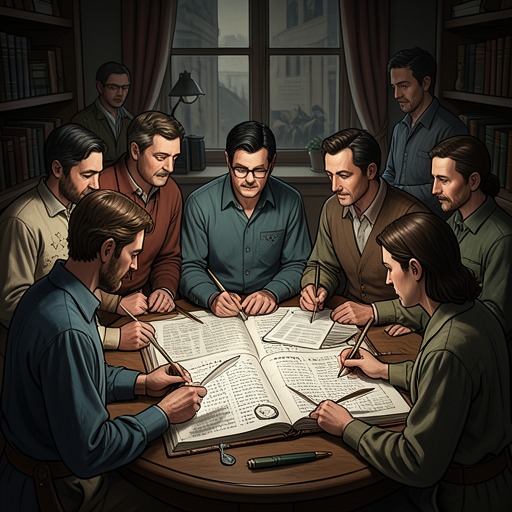
Furnivall called for volunteers to read books from one of three broad periods: 1250 to 1526, 1526 to 1674, or 1674 to the present. The divisions reflected the view that English had developed differently across these periods. Readers offered to work on particular books, made word lists, and then searched for words that the dictionary team especially needed. For each example, they prepared a paper slip with the target word, the date, author, title, volume and page, and the full sentence showing the word in context. The slip system turned scattered reading into usable evidence and remained a working method for lexicographers.
The proposal did not immediately become a sustained editorial enterprise. More than twenty years of sporadic activity followed before the dictionary truly got under way. Murray and Furnivall sought support from Cambridge University Press but were rejected; discussions and lobbying continued while Oxford gradually became more receptive. On 26 April 1878, Murray met the Oxford Delegates. The meeting went better than either side had expected, and the Delegates decided to proceed. Negotiations over the contract then took another year, involving bitter disputes often conducted at a distance. On 1 March 1879, the formal agreement appointed Murray to edit the New English Dictionary on Historical Principles on behalf of the Philological Society.
Murray’s editorial system and Minor’s contribution
The contract imagined a dictionary of roughly 7,000 quarto pages, in four volumes, completed in ten years. The estimate proved a serious underestimate, but the agreement marked the point at which the work began in earnest. Within days Murray decided to build a corrugated-iron shed in the grounds of Mill Hill School as an editorial workplace. He called it the Scriptorium. He also issued a four-page appeal to English-speaking and English-reading readers, seeking help in Britain, America, and the British Colonies to finish reading and extracting works that remained unexamined. Newspapers and magazines printed parts of the appeal; it also circulated through bookshops, newsstands, and libraries.
One copy reached William Chester Minor at Broadmoor Asylum in the early 1880s. Minor was a patient who had been confined there after a murder in London; by the time of his trial in early April 1872, witnesses had made the severity of his illness apparent. His participation in the dictionary thus joined two histories that might otherwise seem far apart: a public scholarly enterprise and the life of a man contributing from an asylum. Murray’s later account says that Minor became a very good reader and wrote often, and that Murray initially supposed he was a retired medical man with ample free time.
Murray learned by chance that Minor’s address, Broadmoor, Crowthorne, Berkshire, belonged to a large asylum, but the correspondence remained confined to dictionary materials. He was grateful for Minor’s substantial help and surprised by the rare, expensive books he could consult. Murray’s account, written in a 1902 letter to Francis Brown, corrects a more theatrical story of how the two men met. It records that their first personal meeting took place in January 1891, after Murray had written to the superintendent to ask permission to visit. Their lunch began a friendship and a series of visits that continued for almost twenty years, grounded in mutual respect and a shared interest in words.
Publication, scale, and the afterlife of the story
The familiar account of the first meeting was popularized by Hayden Church, an American journalist. Church’s story appeared in the Strand in 1915 after an earlier, anonymous version in the Sunday Star, and it presented Murray as discovering that the learned contributor he expected to visit was an inmate at Broadmoor. The tale circulated widely and became a compelling romance of scholarship in a cell. Henry Bradley, who had succeeded Murray as editor, publicly objected to factual misstatements and called the most romantic features of the meeting story fiction. The surviving letter Murray wrote to Francis Brown, found among Minor’s relatives’ papers, supplies a more firmly evidenced chronology: contact began around 1880 or 1881, while the first visit occurred in 1891. The correction does not diminish the collaboration; it distinguishes the documented relationship from the dramatic version that later came to stand for it.
The dictionary itself outgrew its original plan in both duration and physical scale. Its first edition, completed in 1928, comprised twelve large volumes and was then called the New English Dictionary. With the first supplement in 1933 it became known as the Oxford English Dictionary. Five supplements followed; a later second edition brought the first edition and its supplements together in a twenty-volume set. The work defines well over half a million words and is notable for grounding each word’s senses in recorded use. Its quotations make visible not just what a word means, but how its meanings and forms have developed over time.
The project’s history therefore rests on a productive tension: the dictionary aimed to document a language too expansive for one person to master, yet its scale depended on editorial decisions that organized the contributions of many readers. Trench’s principle of inclusion required evidence; the volunteer system supplied it; Murray’s editorial enterprise shaped it into a reference work. More than seventy years after the proposal began, the result was not the compact four-volume work its contract had imagined, but a monumental historical dictionary whose method preserved the changing life of English.